The Cost of Complexity
What I Had to Unlearn — and What It Means for Your Portfolio
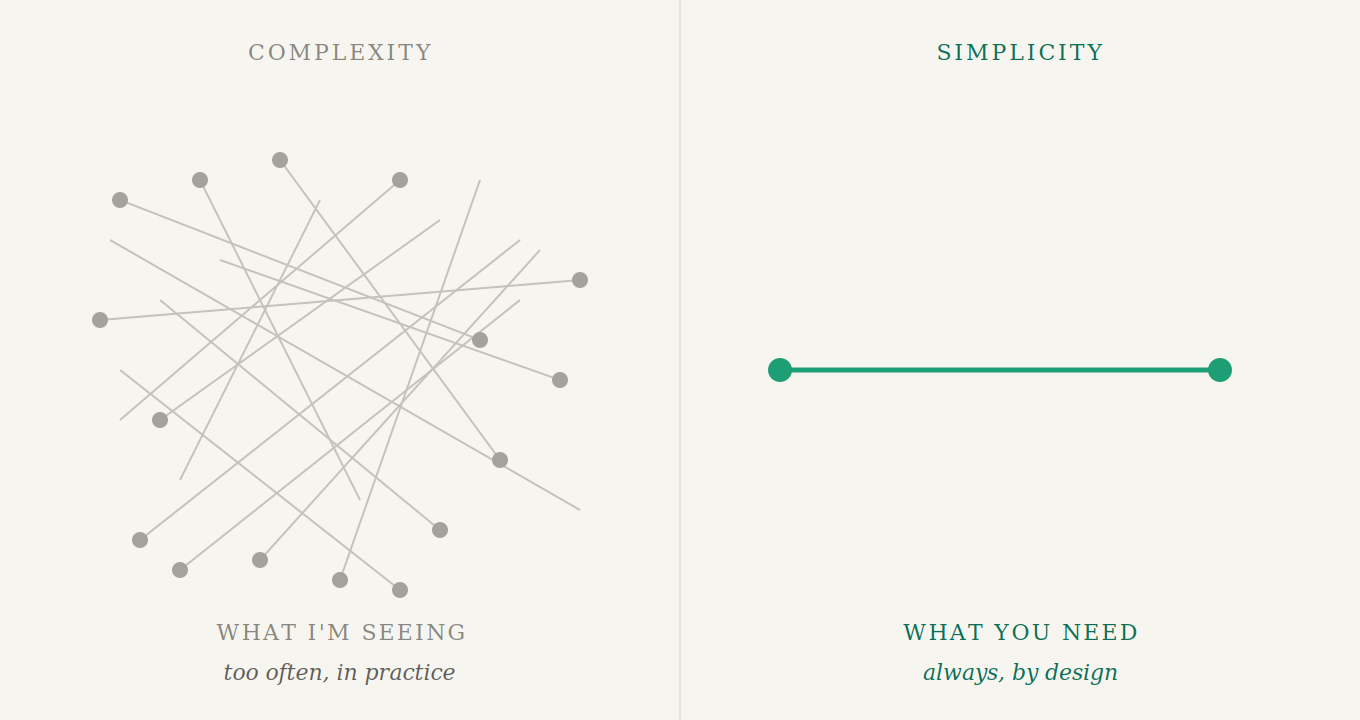
“Simplicity is the ultimate sophistication”
I spent my first decade as a financial advisor at a large broker-dealer. It was a formative education in many ways — but one of the most important things I learned didn't happen in any sort of formal training. It happened slowly, over years of watching portfolios perform, and being willing to question what I'd been taught.
What I had to unlearn was complexity for its own sake. I was a good advisor. I put my clients' best interests first and tried to do the best I could for them. I was schooled in the idea that compounding more consistent returns and building portfolios that minimized downside risk ultimately outperformed over time. And when you can build them in a rearview mirror, they absolutely do. But the future is much less certain. Trying to predict it — or choosing managers who think they can — is a fraught endeavor. Even if they did a good job of it in the past, I have yet to see a single manager who did so on a long-term basis. I found myself having to replace most managers I hired within 10 years, because within that period they ultimately began to underperform their benchmarks. When I compared my clients' portfolio performance over 1, 3, 5, and 10 years against an evidence-based, low-cost, factor-based portfolio, the data was clear. I could do better by embracing the latter.
Eight years ago, when I made the decision to go independent, I made another decision simultaneously: to fully commit to an evidence-based investment approach. It was a clean break — and a deliberate one. Independence gave me the freedom to build portfolios around what academic research actually supports, rather than around what a firm's product shelf makes available or profitable. Most advisors at large broker-dealers are never exposed to evidence-based investing. It isn't part of the training. The focus is on products, platforms, and managed money programs — not on decades of peer-reviewed research into what drives long-term returns. That gap is consequential, and it shows up in the portfolios I review.
A Pattern I Keep Seeing
Lately I've been reviewing several portfolios from a major broker-dealer, and there is one common thread: unnecessary complexity. Products layered upon products. Solutions designed for niche institutional situations effectively mass-marketed to everyday investors who don't need them — and who are ultimately being done a disservice by them.
I understand how it happens. Large broker-dealers have large clients with genuinely complicated situations, and some of that complexity is warranted. But the products developed for those situations don't stay there. They get distributed broadly, often by advisors who were trained to see them as solutions rather than tools — tools with a specific, limited purpose.
The result? Higher costs. Tax drag that compounds over years. And a portfolio that has become difficult to understand, difficult to manage, and difficult to exit without triggering the very problems it was designed to solve.
There's a version of this I encounter often: a product that created a short-term tax benefit but carries long-term drag that will likely erase and then exceed that savings. I remind these clients of something simple: it's not just what you make — it's what you keep. Solving a short-term problem with a solution that creates long-term headwinds isn't a win. It's a deferred loss.
The Active Management Trap
The other pattern I see consistently is a heavy reliance on actively managed funds — higher costs, less tax efficiency, and a historical track record that, despite looking impressive on paper, tends not to persist.
It is genuinely easy to build a list of managers who have outperformed on a 1, 3, 5, and 10-year basis. Any screening tool will surface them in minutes. The problem is that past performance is not an indicator of future returns. We've all read that disclaimer so many times it's become invisible — but it could not be truer.
Even when you carefully select managers with exceptional track records across multiple time horizons, the research is clear: most of them do not continue to outperform. What you're observing in those track records is, more often than not, luck rather than skill. And even in the cases where genuine skill is present, it is extraordinarily difficult to distinguish from luck — and skill that works in one market cycle often does not translate to the next.
What We Do Instead
In a world full of market noise, hot tips, and the investment trend of the moment, we anchor our approach in something more durable: decades of peer-reviewed academic research and empirical evidence.
Evidence-based investment management isn't about chasing returns or timing the market. It's about building portfolios grounded in what works over the long term — drawing on the established principles of modern portfolio theory, factor-based investing, and behavioral finance to construct diversified portfolios designed to capture market returns while managing risk appropriately for your situation.
This means focusing on what you can control: costs, tax efficiency, asset allocation, and disciplined rebalancing. Not attempting to predict the unpredictable.
By removing emotion and speculation from the equation, we help clients avoid the costly mistakes that erode wealth over time — and stay focused on their long-term goals through every market condition.
Our approach doesn't promise to beat the market every year. It promises something more valuable: a systematic, transparent strategy built on principles that have stood the test of time — and the confidence to stay invested when it matters most.
Raymond James and its advisors do not offer tax or legal advice. You should discuss any tax or legal matters with the appropriate professional.
Kathy Reisfeld, CFP® CIMA®, is the founder of Berkshire Wealth Group, a wealth management practice in Great Barrington, MA. She is affiliated with Raymond James Financial Services, Inc., member FINRA/SIPC. The information contained in this article is for informational purposes only and does not constitute investment advice or a recommendation to buy or sell any security. Past performance is not indicative of future results. All investing involves risk, including the possible loss of principal. The hypothetical portfolio returns referenced are illustrative only and do not represent the performance of any actual account. Diversification does not guarantee a profit or protect against loss in declining markets. Any opinions are those of Kathy Reisfeld and not necessarily those of Raymond James. Expressions of opinion are as of this date and are subject to change without notice. Every investor's situation is unique and you should consider your investment goals, risk tolerance and time horizon before making any investment. Prior to making an investment decision, please consult with your financial advisor about your individual situation. There is no guarantee that these statements, opinions, or forecasts provided in the attached article will prove to be correct.